Showing posts with label injury prevention. Show all posts

Thursday, July 30, 2009

Reports of Injuries from Wii Sports and Wii Fit

Whenever a certain colleague of mine mentions the Wii, talk of fear of injuries to players creeps into the conversation. An article appeared recently in the New York Times entitled, More Wii Warriors are Playing Hurt. Readers find references to strains and sprains as well as rotator cuff tears and knee injuries. This article suggests that Wii related injuries are increasing along with the popularity of the Wii gaming system, itself. In the therapeutic setting, I have not had any experience with patients adding to their injuries or pain using the Wii, because we are very careful to follow the"Play It Safe" (for Wii Sports) suggestions while working with patients. Earlier this summer though, I met someone who had broken his toe playing the Wii. Aaron Martin, a delightful and inspiring speaker, known best as the face of BASSEDGE, related the story of how he broke his toe playing a Wii game with friends. He hit his foot on a chair as he lunged to make the play. A reminder ofPoint # 4 from the "Play it Safe" sheet may have helped Aaron avoid that injury.

Although reports fill the internet of Wii related injuries to players and equipment, many more reports tout the benefits of using the Wii. Any activity can result in injury if the participant over-indulges or disregards safe practices. Using Wii Fit in therapy requires additional safety measures to insure against potential falls, especially when using this tool to improve balance and encourage weight-shifting in an elderly population. Safe use of therapeutic tools is common sense and usual practice for therapists. I always remind my colleague that stories of Wii injuries relate to public use of the gaming system, not to the supervised use of Wii as a therapeutic tool for Wii-hab.

Monday, July 28, 2008

Printout: Wii - Play it Safe

Playing the Wii is a great activity for older adults living in retirement communities. These independent elders are excited to find a computer related activity that both contains subject matter familiar to them (Bowling, Baseball, Tennis) and presents new technology in an easy to learn format. The enthusiasm that Wii generates may result in over-indulgence in the activity.

For maximum enjoyment, suggestions for the safe use of the Wii Gaming System should be posted in an obvious spot near where the game is set up for casual use. Below is a Safety Tip Sheet from The Wii OT, Mershon W. Hinkel, MSPH, OTR/L, that may be copied and placed either in a free-standing frame on the table top, or on the wall where the Wii is being used.

Wii PLAY IT SAFE

Wii is a great activity for all ages. By using a wireless remote, Wii has taken "playing" video games off the couch. Wii games are a physical activity, a social activity, and a wonderful way to interact with younger generations.

For an enjoyable, safe, and healthy time playing the Wii, follow the guidelines below:

1. Always use the included Wii wrist strap and the Wii remote safety jacket. The wrist strap prevents accidentally dropping or throwing the remote, and the jacket gives the remote a softer and less slippery surface.

2. Don't overdo it, especially when you're first starting out. Like with playing any new game or sport, you may find yourself using muscles you don't usually use, and these muscles may become strained or sore. Stretching before playing and using ice to relieve any soreness after playing can protect muscles and tendons from injury.

3. If you are concerned about your ability to balance, many of the Wii games can be played sitting down. You may also wish to use a form of support for extra safety to avoid falling.

4. Be sure the playing area is clear of potential obstacles that may get in the way of your arms or legs when playing. Be sure you are not too close to other players or observers.

5. If you have a condition such as epilepsy, are prone to motion sickness, or have a pacemaker, you may want to discuss using Wii and other video games with your health care provider prior to playing.

6. To avoid the spread of germs, wipe the remote's surface with a sanitizing wipe. Players may also want to use hand sanitizing gels between turns.

Monday, July 21, 2008

Safety Tips for Wiihab Therapy

Maintaining a safe environment for patients during therapy is always important. A good therapist should pay attention to and avoid potential risks. For example, therapists should think about fall prevention, infection control, and injury prevention in conjunction with any modality they choose to use, including Wii. Avoiding injury to other people (or damage to furniture, belongings, or equipment) is also important.

Fall Prevention and Wii

Many Wii games can be played from a seated position. However, sometimes the goals of therapy include getting a patient to stand and balance. For a patient whose balance may be in question, the therapist may wish to use a gait belt. Another option would be to use parallel bars for support or for safety, or using a walker with therapist at the side. For example, while the Wii balance board is very sensitive to shifts in weight, it can still be effectively used to train balance while the user relies partly on upper-body strength to support the lower body.

When using the balance board, be sure it is not on a slippery surface and that other people will not trip over it. The balance board is white and may be difficult to see on a white or light colored floor, especially for patients with low vision. This potential risk can be mitigated by placing the balance board on top of a non-stick mat, such as a yoga mat, in a darker color. For patients at risk for falls, Wii use that involves standing should always be supervised.

Infection control and Wii

If the Wii equipment is shared in a clinic setting, it must be appropriately cleaned between uses to prevent potential transfer of any pathogens (germs).

To fully clean the remote, the protective safety jacket should be removed from the remote. The jacket can be immersed for cleaning, but the remote can NOT be immersed. The remote itself should be wiped with disinfectant solution readily available in the clinic (use the same wiping method as for similar plastic items). The Wii remote strap can be removed and washed as well. (See the photo below of a Wii remote with safety jacket and with jacket removed.)
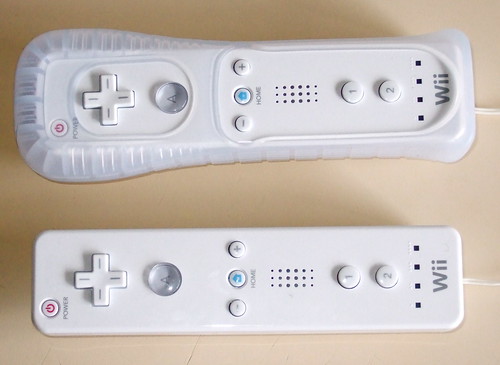
Wii Remote Jackets
Photo by frostova on Flickr

Also, users can wear latex gloves while handling the remote for extra precaution.

Injury Prevention and Wii

Therapists incorporating Wii into a therapeutic plan should use the same strategies that they would use if a person had started a new sport. For example, if the patient has been bothered by a wrist or elbow in the past, the therapist may consider using ice and monitoring a patient to prevent overuse. Because of the "fun" element involved in Wii, overuse may be of particular concern. Also, therapists should make sure all movements are being done correctly and that patients do not compensate for a weak muscle with a stronger muscle group.

Avoiding injury to others or damage to equipment with the Wii

In the early days of the Wii, anecdotes of Wii bowlers accidentally throwing the Wii remote through a television screen abounded. The Wii remote's safety strap and safety instructions given at the start of each Wii session and game, as well as the new safety jacket, should help prevent this type of damage (or injury that could result if the remote hit another person).

Always clear the area of potential hazards or obstructions before using the Wii, make sure he safety strap is secured to the player's wrist, and use the padded secure-grip safety jacket on the remote (see the photo above of the remote with and without the safety jacket). Also, follow all safety precautions given by the Wii software.