Share your stories!
Showing posts with label alternating movements. Show all posts
Showing posts with label alternating movements. Show all posts
Monday, February 23, 2009
Following Stroke, The Wii Encourages Bilateral Upper Extremity Use
Using Wiihab encourages many responses. Often occupational and physical therapists are challenged to find therapeutic activities to elicit one desired response, bilateral upper extremity use. Those recovering from stroke may find using the involved extremity uncomfortable and challenging because of muscle weakness, increased or decreased muscle tone, poor sensation, or loss of position sense (proprioception). Boxing in Wii Sports, especially, offers an opportunity to use both upper extremities reciprocally and spontaneously. Boxing in virtual reality creates a need to make alternating movements with the arms to protect yourself from punches or to knock out your opponent. If the participant's bilateral cordination is sluggish, their opponent will punch them. Many will work hard to avoid that! All of the Wii games promote therapeutic movement and many news reports explain the value patients find in using games as therapy.


Tuesday, July 15, 2008
Using Mario Kart in Wiihab (Part 1 of 6)
Have you thought about using Mario Kart in therapy but are wondering what goals it can help your patients reach? This post is the first in a series of six on areas that Mario Kart can target for improvement as part of a rehab plan. Many of the areas that will be described in this series are important in conditions including pervasive developmental disorders and sensory integration dysfunction.
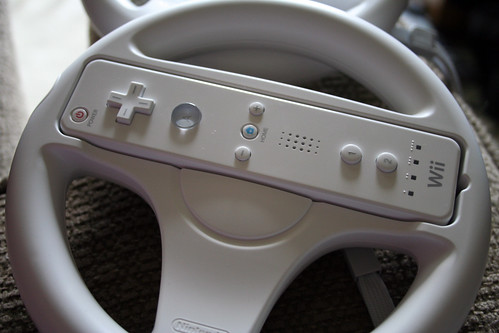
Photo by SMercury98 on Flickr
Bilateral coordination is the coordinated use of both sides of the body at the same time, either in similar movements or in alternating movements. An example of a similar movement is using both hands to pick up an object or using both hands to throw a beach ball; an example of alternating movement is walking up the stairs or pedaling with the feet or the hands.
In Mario Kart Wii, players insert the regular Wii remote, which is rectangular in shape, into a wheel-shaped adapter. Because the wheel Wii controller is held and controlled with both hands, bilateral coordination is involved in playing the game.
Also, effective playing of the game can involve alternating movements, such as holding down the "2" button to speed up the kart while using the "b" button on the reverse of the controller to "drift" while in manual mode. (Manual mode is optional, and less advanced patients can play in automatic mode.)
Photo by SMercury98 on Flickr
Post 1: Bilateral Coordination
Bilateral coordination is the coordinated use of both sides of the body at the same time, either in similar movements or in alternating movements. An example of a similar movement is using both hands to pick up an object or using both hands to throw a beach ball; an example of alternating movement is walking up the stairs or pedaling with the feet or the hands.
In Mario Kart Wii, players insert the regular Wii remote, which is rectangular in shape, into a wheel-shaped adapter. Because the wheel Wii controller is held and controlled with both hands, bilateral coordination is involved in playing the game.
Also, effective playing of the game can involve alternating movements, such as holding down the "2" button to speed up the kart while using the "b" button on the reverse of the controller to "drift" while in manual mode. (Manual mode is optional, and less advanced patients can play in automatic mode.)
Subscribe to:
Posts (Atom)

 Posts
Posts

